

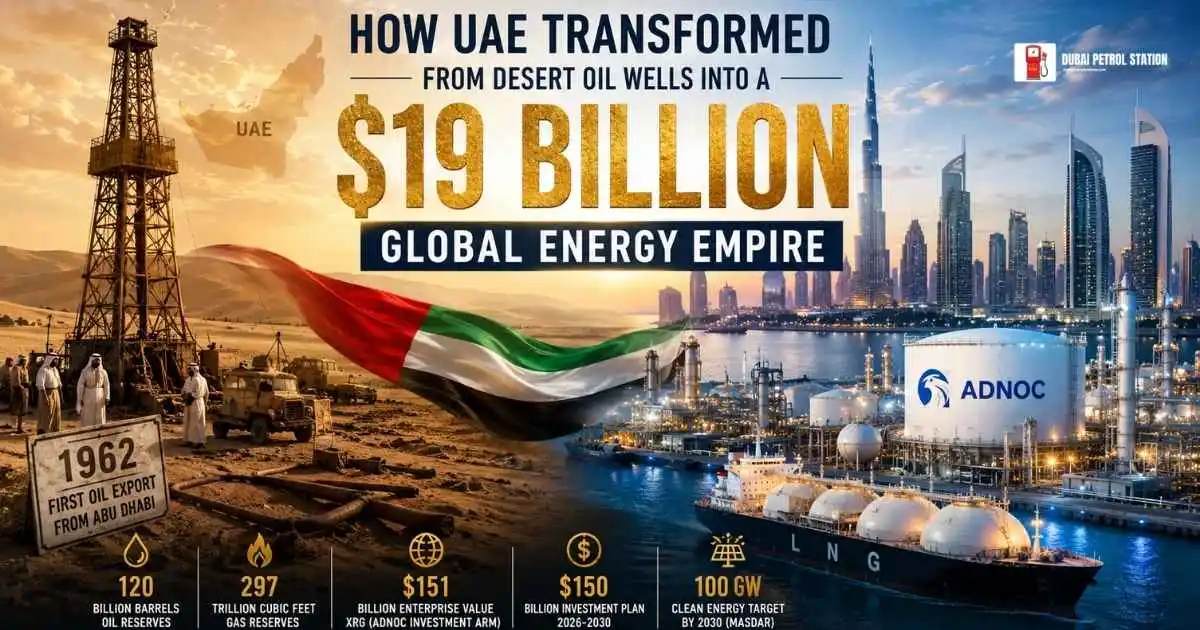
Dubai Oil Globalisation: In 1958, a drill bit broke through the sand of Abu Dhabi and hit something that would rewrite history.
Not just for the UAE, but for the entire global energy map.
Nobody in the small fishing villages along the Arabian Gulf coastline could have imagined that within 60 years, this same strip of desert would control one of the most powerful petroleum networks on earth. Yet here we are.
Dubai, specifically, played a quieter but smarter game than its neighbours. While Abu Dhabi sat on the bulk of the crude, Dubai built the infrastructure, the trade routes, and the global relationships that turned raw oil into a $19 billion empire. Also read: ADNOC’s $1 Billion Deal.
Dubai Oil Globalisation: The Numbers That Actually Matter in 2026
Before the story, here’s the scale, because the numbers are genuinely staggering.
| Metric | Figure |
|---|---|
| UAE Proven Oil Reserves | ~100 Billion Barrels |
| Global Ranking (Reserves) | 6th Worldwide |
| Oil’s Share of UAE GDP | ~30% |
| UAE Oil & Gas Market Size (2026) | USD $14.94 Billion |
| Projected Market Size (2031) | USD $19.11 Billion |
| ADNOC Daily Production Target (2027) | 5 Million Barrels/Day |
| ADNOC Petrol Stations (Q3 2025) | 977 Stations |
| UAE Fuel Station Market Size (2026) | USD $17.40 Billion |
Sources: UAE Ministry of Energy, ADNOC Annual Report 2025, S&P Global
Why Dubai, Not Just Abu Dhabi, Became the Global Gateway
Here’s what most people get wrong: they assume Dubai’s oil story is Abu Dhabi’s story.
It isn’t. Abu Dhabi holds 96% of the UAE’s crude reserves. But Dubai built the architecture around those reserves that gave the UAE its global energy clout.
Dubai’s 5 Strategic Advantages in the Global Oil Game:
- 🌍 Geography: Positioned exactly between the East and West, Jebel Ali Port handles more oil trade than most nations produce
- 🏦 Finance: The Dubai International Financial Centre (DIFC) became the region’s oil trading hub
- ✈️ Logistics: World-class airports and free zones attract every major energy company on earth
- 🤝 Diplomacy: Dubai hosts the world’s most critical energy conferences, including COP28 in 2023
- ⚙️ Downstream: While Abu Dhabi drills, Dubai refines, distributes, and exports the finished product
This division of labour is no accident. It was engineered.
The Three Eras of UAE Oil Globalisation
Era 1, Discovery & Dependence (1958–1990)
Oil revenue flooded in. The UAE built roads, hospitals, and cities almost overnight. Everything ran on petroleum money. The risk? Putting all your eggs in one basket.
Era 2, Diversification Without Abandonment (1990–2015)
Dubai made its smartest move: it stopped depending on oil while never stopping profiting from it. Tourism, finance, and real estate grew. But oil remained the silent engine underneath.
Era 3, Globalisation & Expansion (2015–Present)
ADNOC’s $150 billion investment programme launched. Production targets pushed toward 5 million barrels per day. New deals signed across Asia, Africa, and Europe. The UAE stopped being an oil producer and became an oil empire.
What Dubai’s Petrol Retail Market Looks Like Right Now
On the ground level, the petrol station economy in Dubai tells its own story.
| Operator | Stations (UAE) | Key Advantage |
|---|---|---|
| ADNOC Distribution | 977+ | Widest network, loyalty programme |
| ENOC / EPPCO | 130+ | Dubai-focused, premium locations |
| Emarat | 145+ | Competitive pricing, strong Abu Dhabi presence |
Current UAE Fuel Grades & Approximate 2026 Pricing:
- Special 95: AED 2.63/litre (most commonly used)
- Super 98: AED 2.75/litre (premium grade)
- E-Plus 91: AED 2.55/litre (budget grade)
- Diesel: AED 2.72/litre (commercial fleet)
💡 Quick Fact: UAE petrol prices are set monthly by the Fuel Price Committee, directly linked to global Brent Crude benchmarks. When Brent moves, your pump price follows, usually within 30 days.
The Globalisation Numbers Nobody Talks About
ADNOC doesn’t just sell oil to the world; it has locked in the world’s future energy supply through long-term agreements.
Key Global Partnerships (Active 2025–2026):
- 🇮🇳 India: 15-year LNG supply agreements worth billions
- 🇨🇳 China: UAE’s largest crude oil export destination
- 🇰🇷 South Korea: Major refining and petrochemical partnerships
- 🇩🇪 Germany: New energy security MOU signed post-2022
- 🇯🇵 Japan: Decades-long crude supply relationship, now expanding into hydrogen
The Elephant in the Room: Net Zero by 2050
Here’s the paradox that every energy analyst is arguing about right now.
The UAE has committed to Net Zero emissions by 2050, while simultaneously investing $150 billion to increase oil production to 5 million barrels per day.
Is that a contradiction? The UAE’s answer: No; it’s sequencing.
The logic: maximise oil revenue now → fund the renewable transition → arrive at Net Zero without destroying the economy. Whether that works is the debate of the decade.
What’s already happening on the ground:
- EV charging points appearing at ADNOC and ENOC stations across Dubai
- Hydrogen pilot stations in development
- UAE’s Mohammed bin Rashid Al Maktoum Solar Park, one of the world’s largest
The Bottom Line
Dubai didn’t just find oil. It built a global energy civilisation around it.
From a pearl-diving coastline in 1950 to a $19 billion petroleum empire in 2026, the transformation is one of the most remarkable economic stories in modern history.
The wells are still producing. The pipelines are still flowing. And the strategy to ensure the UAE thrives even after the last barrel is pumped? That’s already been running for 30 years.

Leave a Reply