

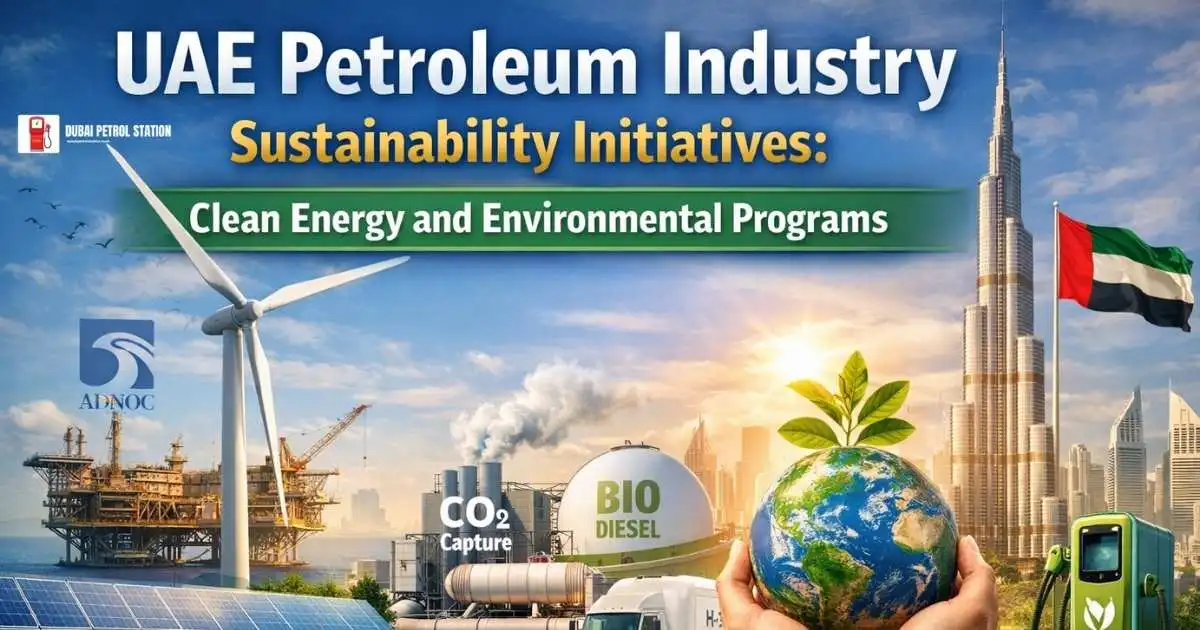
UAE Petroleum Industry Sustainability Initiatives: The UAE’s oil and gas sector is actively shifting toward clean energy and environmental stewardship. Government bodies and major companies are launching programs to lower carbon emissions, boost renewable power, and adopt advanced technologies. For example, the UAE Ministry of Energy reports that renewable capacity has reached 7.7 GW (as of early 2026) and will exceed 23 GW by 2031.
National targets have been raised to generate 35% of electricity from clean sources by 2031. Ambitious policies – like the UAE’s Net Zero by 2050 goal – are backed by huge investments (over AED 190 billion in renewables to date) and efficiency programs that have saved 14.8 million tonnes of CO₂ and US$2 billion since 2020. Look at the UAE Oil and Gas Market Growth Forecast 2026–2030.
Quick Highlights: UAE Petroleum Industry Sustainability Initiatives
| Focus | Initiative / Target | Impact (Source) |
|---|---|---|
| Renewable target | 35% of UAE power from clean sources by 2031 | |
| Clean power capacity | Installed ~7.7 GW (2026); >23 GW by 2031 | |
| Net Zero pledge | UAE net-zero by 2050; ADNOC aiming net-zero by 2045 | |
| Carbon Capture (Habshan) | ADNOC’s Habshan CCUS: 1.5 Mt CO₂/year capacity by 2030 | (≈500k car emissions) |
| Offshore electrification | New power cable cuts offshore production emissions by ~50% | |
| Zero-flaring & clean power | ADNOC already uses 100% nuclear/solar grid power and zero routine flaring | |
| Biofuels | ENOC’s 20M L/year biodiesel plant (UAE’s first NOC biodiesel) | |
| Energy efficiency | ENOC/Emirates Gas cut energy use ~30% (2014–2024); ~920 t CO₂ avoided (ISO50001) |
Government-Led Sustainability Initiatives
The UAE government has made sustainability a priority in the hydrocarbon sector. The Ministry of Energy and Infrastructure and the Department of Energy (Abu Dhabi) have set higher clean-energy targets and launched national programs.
In 2026, the Energy Minister highlighted that UAE investments in renewables exceed AED 190 billion, and renewable power has grown 117% since 2022. He also noted that the UAE now plans for 35% of its electricity to come from clean sources by 2031.
This includes integrating the National Hydrogen Strategy 2050 into national plansand advancing nuclear and solar projects (like the Mohammed bin Rashid Al Maktoum Solar Park). Efficiency programs (e.g. water & energy demand management) aim to cut consumption by 43% by 2050, helping to save millions of tonnes of CO₂
As the national oil champion, ADNOC (Abu Dhabi National Oil Company) is key in driving these goals. ADNOC has adopted an “Advancing Net Zero” strategy, with a board-approved plan to spend $15 billion (AED55B) on decarbonization projects by 2030. Its goals include slashing carbon intensity 25% by 2030 and reaching net zero emissions (recently updated to 2045).
ADNOC already uses 100% clean grid power (from Abu Dhabi’s nuclear and solar plants) in its operations, and it has eliminated routine flaring of gas as a byproduct. The company is also electrifying its offshore platforms: a new subsea power cable will cut offshore emissions by up to 50%.
Figure: UAE energy officials at a 2026 sustainability conference (ADSW). Government and industry leaders are collaborating on clean-energy projects and policies.
ADNOC’s projects highlight this transition. For example, the Habshan CCUS project in Abu Dhabi will capture 1.5 million tonnes of CO₂ per year by 2030, tripling ADNOC’s capture capacity. ADNOC also opened the Al Reyadah plant (Abu Dhabi’s first CCS facility) in 2016, capturing 800,000 tCO₂/year from steel production.
In addition, ADNOC is scaling up low-carbon fuels: it is developing a world-scale blue ammonia plant (1 million tonnes/year) at TA’ZIZ (Ruwais) and exporting initial cargoes of low-carbon ammonia to Europe and Asia. These efforts are often done with international partners: for instance, ADNOC and the US firm Occidental are exploring carbon capture and storage (CCS) opportunities in the UAE and the U.S..
Globally, ADNOC’s role is growing (e.g. it helped fund Germany’s Covestro chemical company and is deepening UAE–Germany energy ties).
Overall, ADNOC has put sustainability at the heart of its strategy, aiming to “make today’s energy cleaner” while investing in the fuels of tomorrow. Its CEO noted that ADNOC will “fast-track significant investments into landmark clean energy, low-carbon and decarbonization technology projects… underscoring [the] industry leadership as a leading global provider of lower-carbon energy”.
These government-driven and ADNOC-led initiatives are complemented by other federal policies (like Dubai’s Clean Energy Strategy 2050) and Abu Dhabi’s carbon-neutrality goals.
Private Sector and Industry Actions
Major UAE energy companies and suppliers also pursue sustainability. ENOC Group (Emirates National Oil Company, Dubai) has embedded green practices across its operations. It has cut its GHG emissions intensity by ~30% since 2014 through efficiency and better fuel use. ENOC has installed renewable power in its network (about 3.7 MW of solar PV by 2020) and implemented waste-heat recovery and LED lighting to save energy.
It introduced cleaner fuels early – for example, rolling out Ultra-Low Sulphur Diesel (10 ppm) and biodiesel blends (B5, B20, B100) across its fuel stations. ENOC’s 2022 Sustainability Report highlights $100+ million in savings from green initiatives and a 30% drop in energy intensity.
ENOC is investing in new clean-energy projects too. At WETEX 2025, ENOC unveiled the UAE’s first national oil company biodiesel plant. This facility (20 million liters of B5 biodiesel per year) will serve government and industrial customers and is designed to expand from B5 to B20 fuel blend.
ENOC’s CEO emphasized that these projects align with UAE targets to cut emissions and diversify the energy mix, supporting Dubai’s Clean Energy Strategy 2050. ENOC is also improving fuel logistics (e.g. an automated jet-fuel pipeline in Dubai) and working with youth and AI tech to optimize operations.
Emirates Gas (EGAS), an ENOC subsidiary supplying LPG and CNG, has pursued energy management rigorously. It adopted ISO 50001 for energy systems, achieving a 32% reduction in energy intensity over 10 years and cutting about 920 tonnes of CO₂ in savings. These efficiency gains support Dubai’s targets (the company cites the Dubai Integrated Energy Strategy 2030).
EGAS has also invested in clean transportation fuels: it introduced Compressed Natural Gas (CNG) as a “greener” vehicle fuel in Dubai and continues expanding the CNG station network to decarbonize transport.
Other private and utility players contribute too. For instance, Masdar (Abu Dhabi’s renewable-energy arm partly owned by ADNOC) is building new solar and wind farms (like 1,800 MW Phase 6 of Dubai’s solar park, saving 2.36 Mt CO₂/year) and offshore wind partnerships worldwide. These efforts help the petroleum sector by greening the power grid and fueling long-term energy diversification.
FAQs
-
What is the UAE’s goal for oil/gas sustainability?
The UAE aims to balance energy growth with the climate agenda. It plans net-zero emissions by 2050 nationally, and ADNOC updated its target to net-zero by 2045.
Key interim goals include cutting carbon intensity 25% by 2030 and sourcing 35% of power from clean sources by 2031.
-
How is ADNOC reducing emissions?
ADNOC has committed $15 billion to decarbonization projects. It uses 100% clean power from nuclear/solar grids for its facilities, has eliminated routine gas flaring, and is deploying carbon capture widely.
Its flagship Habshan CCUS will trap 1.5 Mt CO₂/year by 2030. Offshore platforms are being electrified to cut emissions by up to 50%.
-
What clean fuels or projects are being developed?
The UAE is investing in clean fuels across the board. ADNOC is expanding hydrogen and ammonia production (e.g. a 1 Mt/year blue ammonia plant at Ruwais with CCS).
ENOC is launching large-scale biodiesel production (UAE’s first NOC plant, 20M L/year). Emirates Gas promotes LPG and CNG as alternatives. Renewable projects (solar, wind, nuclear) are also underpinned by fuel companies’ power needs.
-
Are there any international partnerships?
Yes. ADNOC and other firms partner globally to accelerate technology and investment. For example, ADNOC works with US and European partners on carbon capture and hydrogen.
It helped fund Germany’s Covestro through its subsidiary XRG. Masdar (linked with ADNOC) is investing in wind projects in Europe. These collaborations bring advanced clean technologies to the UAE’s energy industry.
-
How does this affect UAE oil production?
The UAE is maintaining strong oil and gas output but “future-proofing” it. Instead of simply cutting production, the country simultaneously increases production capacity and invests in decarbonization.
This means new oilfields are being developed with lower carbon footprints (e.g. using zero-flare policies), while heavy investments in CCS, renewables and hydrogen reduce the sector’s net emissions. In summary, the UAE is aiming to have “oil in a low-carbon bag.”
Conclusion
UAE oil and gas companies – led by ADNOC and supported by national policy – are pushing hard on sustainability. They are funding carbon capture and new-energy projects, shifting to clean power, and developing biofuels and hydrogen. Energy suppliers like ENOC and Emirates Gas are greening their fleets and operations through renewables, efficiency, and cleaner fuels.
As one ADNOC executive put it, the country is taking “tangible action” on climate by blending pro-growth with pro-climate strategies. These comprehensive initiatives position the UAE’s petroleum sector as a leader in the region’s energy transition, aiming to secure both economic growth and environmental responsibility.


Leave a Reply