

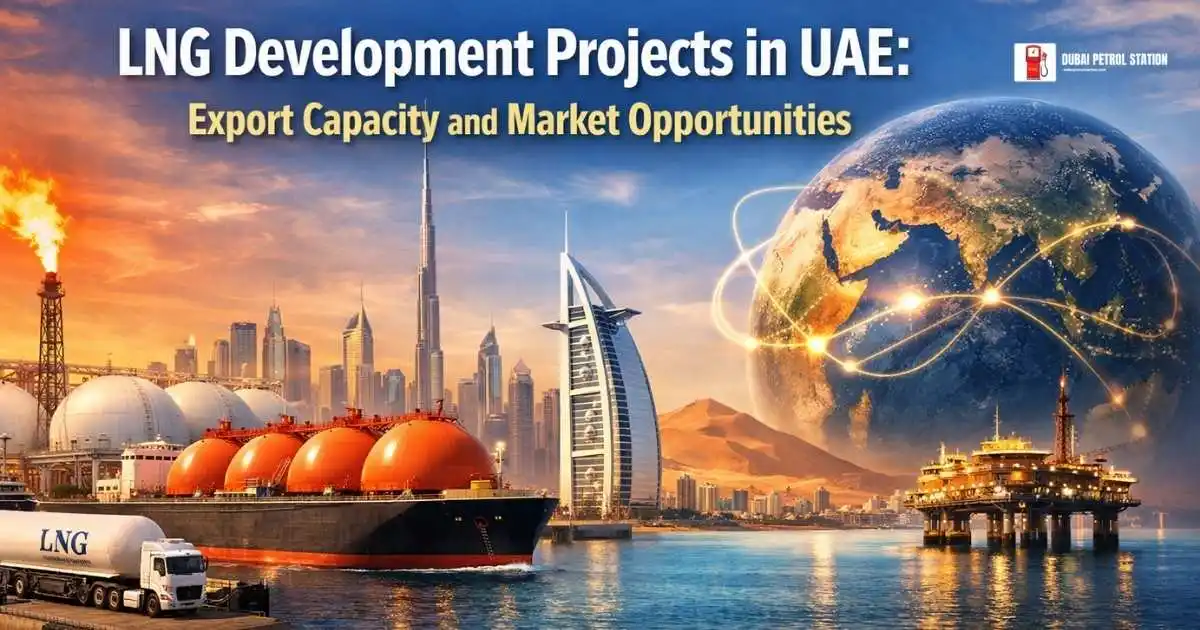
LNG Development Projects: The UAE is rapidly expanding its liquefied natural gas (LNG) sector. With a robust oil and gas background, Abu Dhabi plans to evolve LNG exports to meet booming global demand. This article examines the UAE’s existing LNG infrastructure, major new projects (2024–2026), and the market opportunities driving them.
Meta-summary: The UAE currently exports about 6 MTPA (million tonnes per annum) of LNG from Das Island and plans to grow this to ~15 MTPA with new projects like Ruwais LNG (9.6 MTPA).
Driven by surging demand in Asia and Europe, state energy firms are investing ~$15 billion in LNG capacity and securing long-term supply deals with partners worldwide. See how Carbon Capture Technology in UAE Oil Industry.
Quick Highlights Table
| Indicator | Figure/Detail |
|---|---|
| Current Export Capacity (2025) | ~6 MTPA (ADNOC Gas, Das Island) |
| Planned Export Capacity (by 2029) | ~15.6 MTPA (Das + Ruwais LNG) |
| Ruwais LNG Project | 9.6 MTPA (2×4.8 MTPA); $5.5B EPC; electric drives; starts H2 2028 |
| Major Offtake Contracts | India (HPCL 0.5 MTPA); Shell (1.0 MTPA); EnBW/SEFE (Germany); China’s ENN |
| Project Partners | ADNOC Gas (60%), Mitsui, Shell, BP, TotalEnergies (10% each) |
| Investment Plan (2024–29) | ~$15 billion in LNG/gas projects |
Current LNG Infrastructure and Export Capacity in UAE
- Das Island LNG (ADNOC Gas): The UAE’s existing LNG export capacity is about 6 MTPA from Das Island (Abu Dhabi). This plant has operated for decades and has delivered over 3,500 LNG cargoes globally.
- Shipping and Markets: ADNOC Gas (Abu Dhabi Gas) exports LNG to 20+ countries in Asia, Europe and beyond. Major customers include India (with contracts to HPCL and other firms) and trading companies in Germany and China.
- Other Facilities: The UAE also has smaller LNG infrastructure: an import/regas terminal at Fujairah and a floating import vessel at Fujairah/Khorfakkan for domestic gas needs. However, these do not contribute to exports. Most LNG export activity is nestled in Abu Dhabi.
- Government Role: ADNOC Gas and the UAE Ministry of Energy coordinate capacity expansion. Abu Dhabi targets ~15–16 MTPA of LNG by 2030, roughly doubling the current capacity. This aligns with the UAE’s strategy to diversify its energy economy and leverage natural gas for global markets.
Major LNG Development Projects (2024–2026)
- Ruwais LNG Project (Abu Dhabi): The centerpiece is the Ruwais LNG export plant in Abu Dhabi’s Al Dhafra region. Approved in 2024, it will consist of two liquefaction trains of 4.8 MTPA each (total 9.6 MTPA). Notably, the Ruwais trains are electrically powered using clean energy (e.g. nearby nuclear power) instead of gas turbines, making it the first low-carbon LNG export facility in the Middle East.
- Capacity: On completion, Ruwais will more than double the UAE’s operated LNG capacity from 6 MTPA to ~15.6 MTPA.
- Timeline: Final Investment Decision (FID) was taken in mid-2024. The first train is due online in H2 2028, the second in early 2029. The plant will be ready by late 2028 to meet offtake contracts.
- Cost & Partners: EPC contracts (~$5.5 billion) were awarded to a consortium of Technip Energies (France), JGC (Japan) and NMDC (UAE). International oil majors, Mitsui, Shell, BP, and TotalEnergies each hold a 10% equity stake alongside ADNOC Gas.
- Offtake: Over 7 MTPA of the 9.6 MTPA capacity is already sold under long-term LNG contracts to customers in Asia and Europe. For example, ADNOC Gas signed deals to supply HPCL (India) and Germany’s EnBW/SEFE and China’s ENN.
- Leadership: Dr Ahmed Alebri, CEO of ADNOC Gas, said the Ruwais investment “is a central component of our ambitious international growth plans” and that the company will invest $15 billion in LNG and gas projects over the next five years.
- Other UAE Projects: Aside from Ruwais, the UAE has limited new LNG export projects. Abu Dhabi had planned a Fujairah terminal, but in 2023 shifted that plan to Ruwais for synergies. ADNOC Gas also considered a Das Island Debottlenecking (LNG 2.0) project to add ~1 MTPA, but cancelled it in 2024. Instead, focus is on optimizing existing plants and on Ruwais. Sharjah’s Khorfakkan and Fujairah facilities remain imports/regasification only.
Market Opportunities and Global Demand
The surge in global gas demand is creating strong opportunities for UAE LNG exports:
- Rising Demand in Asia and Europe: Countries like India, China, South Korea and Japan are seeking reliable LNG supplies. Energy analysts note that “global gas demand is going to be much, much more than the projects that we are seeing,” reflecting a tight market. The UAE’s LNG deals reflect this: India alone has secured ~0.5 MTPA from the UAE (HPCL contract), and Europe has deals (Shell for 1 MTPA from Ruwais, and contracts with Germany’s EnBW/SEFE).
- Strategic Partnerships: ADNOC is building partnerships with global firms. For example, ADNOC Gas signed a 15-year agreement to supply Shell with 1.0 MTPA from Ruwais starting 2028. It has also made equity investments abroad: ADNOC’s XRG acquired stakes in US projects like Rio Grande LNG and Sabine Pass, securing U.S. LNG offtakes (1.9 MTPA). As XRG’s Mohamed Al Aryani noted, expanding these investments “reinforces our commitment to our global gas strategy and…providing reliable and flexible energy supply to international markets”.
- Location Advantage: The UAE sits between Asia and Europe with stable infrastructure and deep-water ports. Its ability to link gas fields (like those in Abu Dhabi and via pipelines from Oman) to Gulf export terminals is an advantage. ADNOC emphasises low-carbon LNG (e.g. Ruwais on nuclear power) to meet buyers’ sustainability targets.
- Market Outlook: Global studies forecast continued LNG growth. The IEA reports that LNG supply grew ~7% in 2025 and expects even faster growth in 2026, with demand rising ~2% mainly due to China and emerging Asian markets. Meanwhile, EU plans to phase out Russian gas by 2027, further opening markets to Gulf suppliers. UAE Energy Minister Suhail al-Mazrouei has said that UAE will expand exports because “global demand for natural gas is outstripping investment in production,” citing forecasts of 600–700 MTPA by 2035. This strong outlook underpins UAE’s aggressive expansion plans.
- Quotes: Industry leaders highlight the momentum. Ahmed Al Dhaheri, CEO of NMDC Energy (part of Ruwais consortium), commented: “Utilizing nuclear energy for LNG production…sets a new international standard for low-emission energy”. Technip Energies CEO Arnaud Pieton similarly said, “By powering electrified LNG trains with nuclear energy, this project sets a new standard for energy security and sustainability”. These statements underscore the UAE’s aim to offer cleaner LNG.
Challenges and Future Outlook
While prospects are strong, several challenges could affect UAE’s LNG ambitions:
- Gas Supply Limits: The UAE has finite gas reserves and already imports some gas (via pipelines from Qatar and Oman). Sustaining 15+ MTPA exports will require continued upstream investment (gas field development and enhanced recovery). Any shortfall in supply could constrain export plans.
- Market Competition: Other Gulf states (especially Qatar with its North Field expansion) and countries like Australia and the US are also ramping up LNG. The UAE must compete on price, reliability, and low-carbon credentials.
- Price and Demand Volatility: LNG markets remain volatile. Recent years saw gas price swings due to geopolitics and weather. Fluctuating prices could impact project returns and export economics in the medium term.
- Environmental Pressures: Even though Ruwais is low-carbon, LNG is a fossil fuel. Concerns over methane leakage and long-term climate targets may pressure demand growth beyond 2030. The UAE is mitigating this by using clean power and emphasizing LNG as a bridge fuel.
- Technological and Policy Risk: New technologies (hydrogen, renewables) and global policy shifts toward net-zero might eventually curb fossil fuel demand. However, short- to mid-term demand (2025–2035) is expected to remain high, as noted by industry forecasts. The UAE is betting that its LNG exports can help meet that near-term demand while it also invests in renewable and hydrogen projects for the longer term.
FAQs
-
What is the UAE’s current LNG export capacity?
As of 2026, the UAE has about 6 MTPA of LNG export capacity, all at Abu Dhabi’s Das Island facility. This plant (run by ADNOC Gas) has been operating for decades. The rest of the UAE’s LNG infrastructure (e.g. Fujairah or Sharjah terminals) handles imports and regasification, not exports.
-
What major LNG projects are underway in the UAE?
The flagship project is Ruwais LNG in Abu Dhabi: two new trains (4.8 MTPA each) adding 9.6 MTPA capacity. FID was given in 2024.
Ruwais will be the region’s first export facility powered by clean energy. Other planned expansions (like upgrading Das Island) have been deferred. ADNOC Gas is focusing on completing Ruwais and related gas development projects.
-
Who are the main customers for UAE LNG?
The UAE’s LNG deals are largely with Asian and some European buyers. India is a top customer (for example, ADNOC signed a 0.5 MTPA, 10-year deal with HPCL).
Other contracts include Shell (global) for 1.0 MTPA and Germany’s EnBW/SEFE. China’s ENN Energy also has offtake contracts. These partnerships secure most of Ruwais’ output before start-up.
-
When will the Ruwais LNG plant start up?
Construction began after the 2024 investment decision. The first train is expected to start liquefying gas in late 2028, with the second train online in early 2029.
This timeline is on track, and ADNOC has said commissioning will be complete by Q4 2028.
Final verdict
The UAE is positioning itself as a rising LNG exporter. With 6 MTPA already online and the 9.6 MTPA Ruwais project on the way, Abu Dhabi will nearly triple its export capacity by 2029. These projects align with booming gas demand in Asia and Europe, and strategic partnerships (India deals, Shell, etc.) lock in sales. By using clean energy for Ruwais, the UAE also addresses environmental concerns.
As Dr. Ahmed Alebri of ADNOC Gas put it, these investments are part of an “ambitious international growth plan” . In short, the UAE’s LNG developments aim to turn a surplus of natural gas into a valuable export commodity, helping meet global demand while supporting the country’s economic diversification.


Leave a Reply