

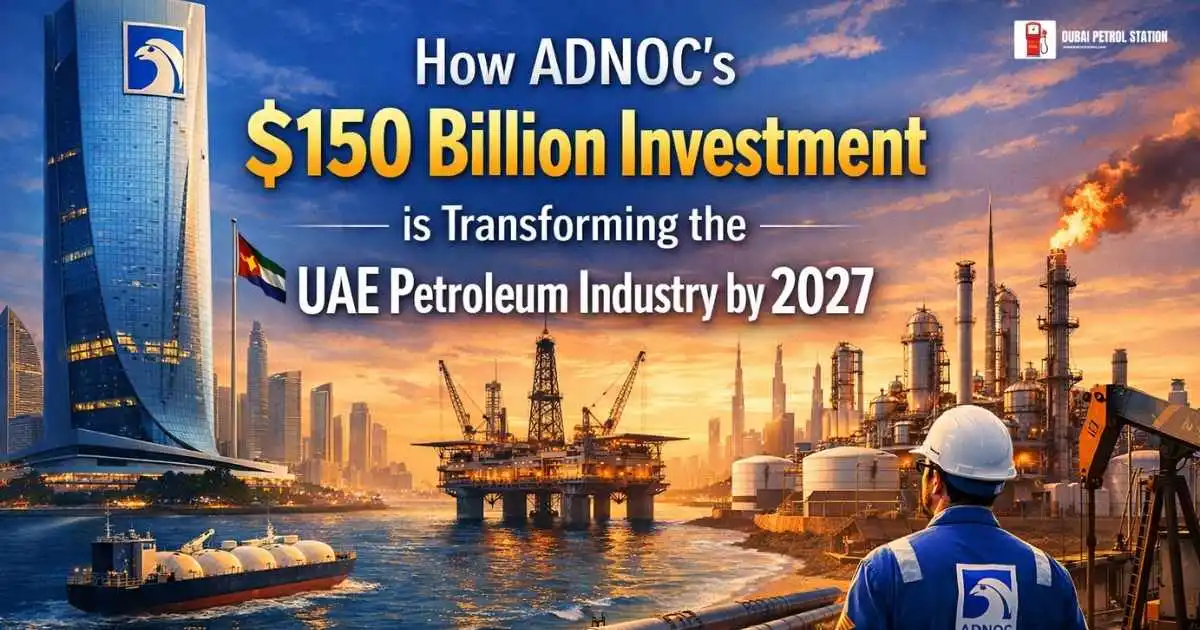
ADNOC’s massive $150 billion investment plan from 2026-2030 is reshaping the UAE’s oil and gas sector, boosting production and driving sustainability.
As a Dubai resident, I’ve watched this unfold closely. It’s a game-changer for Dubai’s UAE oil and gas market and beyond. Explore the UAE Petroleum Industry Sustainability Initiatives.
Quick Highlights of ADNOC’s $150 Billion Investment
Here’s a snapshot of the key impacts in a table for easy scanning:
| Aspect | Key Impact by 2027 | Details finance.yahoo+2 |
|---|---|---|
| Oil Production Capacity | 5 million b/d target achieved | Accelerated from 2030 goal |
| Gas Development | Unconventional resources unlocked | 160 TCF gas, 22B barrels oil |
| Downstream Expansion | Chemicals and refining scaled up | Low-carbon value chains |
| Economic Boost | $60B to UAE economy via ICV program | Jobs, industrial growth |
| Tech Integration | AI, robotics across operations | World’s most AI-enabled energy firm |
The Investment Breakdown
This $150 billion capex, approved in late 2025 by ADNOC’s board under Sheikh Mohamed bin Zayed Al Nahyan, spans 2026-2030 but hits stride by 2027. It sustains upstream capacity while pouring funds into gas, downstream, and chemicals, key for UAE petroleum industry transformation.
Upstream sees major pushes in Abu Dhabi’s unconventional plays, like the Ghasha concession, yielding 1.8 BCF/d gas and 150,000 b/d oil. Downstream investments build low-carbon chains using clean grid power, aligning with the UAE’s diversification.
Boosting Production and Reserves
ADNOC aims for 5 million b/d oil capacity by 2027, producing low-carbon barrels like Murban crude, half the global intensity average. Reserves jumped recently: oil to 120 billion stb, gas to 297 TCF, fueling confidence.
By 2026 updates, projects like field expansions are on track, with AI-driven discoveries adding billions of barrels equivalent. This secures the UAE as a reliable supplier amid global demand.
Tech and Sustainability Drive
ADNOC is becoming “the world’s most AI-enabled energy company,” deploying analytics, robotics, and autonomous ops. Sultan Ahmed Al Jaber, ADNOC CEO, emphasised long-term oil demand: “Oil demand will hold above 100 million bpd through 2040.”
Sustainability shines with net-zero Scope 1+2 by 2050, via CCUS, efficiency, and renewables, vital for Dubai, UAE oil and gas market enthusiasts in tier-1 nations.
Economic Ripple Effects
The plan injects $60 billion domestically through In-Country Value (ICV), building on $83.7 billion since 2018. It creates jobs, spurs “Make it in the Emirates,” and cuts reliance on crude exports.
International arm XRG’s value hit $151 billion by 2026, expanding the UAE’s global footprint.
Dubai’s Stake in UAE Oil Boom
While Abu Dhabi-led, Dubai benefits via shared infrastructure and markets, think Ruwais refining hub supplying Dubai petrol stations. For UAE petrol price watchers and investors from the US, UK, or Saudi Arabia, this means stable supply and innovation spillover.
FAQs
-
What is ADNOC’s $150B plan exactly?
A 2026-2030 capex to expand oil/gas output, downstream, and tech, approved in 2025.
-
How does it hit by 2027?
Core milestones like 5MM b/d oil capacity and Ghasha gas online by then.
-
Impact on UAE petrol prices?
Indirectly stabilizes via higher production and efficiency, keeping Dubai fuel competitive.
-
Is it sustainable?
Yes, focus on low-carbon tech, CCUS, aiming net-zero by 2050.
-
Global effects for tier-1 investors?
Boosts UAE exports, AI energy leadership, drawing FDI.
Conclusion
In wrapping up, ADNOC’s bold move cements the UAE’s energy dominance through 2027 and beyond, blending growth with green tech for a resilient Dubai, UAE oil and gas market. Stay tuned via dubaipetrolstation.com for petrol updates.


Leave a Reply